

Welding is a manufacturing process used to join materials, usually metals or thermoplastics, by applying heat, pressure, or both. This process creates a strong and permanent bond between the workpieces. Welding plays a important role in industries such as construction, automotive, aerospace, and shipbuilding.
Welding processes are categorized based on the source of heat, method of application, and type of materials being joined. Below are the main types of welding processes.
1. Arc Welding Processes #
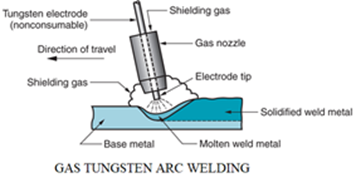
Arc welding uses an electric arc to generate heat for melting and fusing metals.
a) Shielded Metal Arc Welding (SMAW)
Also known as manual metal arc welding or stick welding:
- Uses a consumable electrode coated with flux
- Flux produces a shielding gas and slag to protect the weld
- Commonly used in construction and repair work
Advantages:
- Simple equipment
- Works outdoors and in windy conditions
Limitations:
- Requires skill
- Slower process compared to others
b) Gas Metal Arc Welding (GMAW / MIG Welding)
- Uses a continuously fed wire electrode
- Shielding gas (argon or CO₂) protects the weld
Applications:
- Automotive manufacturing
- Sheet metal work
Advantages:
- High welding speed
- Easy to automate
c) Gas Tungsten Arc Welding (GTAW / TIG Welding)
- Uses a non-consumable tungsten electrode
- Filler metal may or may not be used
Applications:
- Aerospace
- Thin metals like stainless steel and aluminum
Advantages:
- High-quality welds
- Precise control
Limitations:
- Slower and more expensive
d) Flux-Cored Arc Welding (FCAW)
- Similar to MIG but uses a flux-filled wire
- Can be used with or without shielding gas
Advantages:
- Suitable for thick materials
- High deposition rate
2. Gas Welding Processes #
Oxy-Acetylene Welding
- Uses a flame produced by burning acetylene in oxygen
- Flame temperature can reach around 3,500°C
Applications:
- Repair work
- Pipe welding
Advantages:
- Portable equipment
- No need for electricity
Limitations:
- Slower and less precise than arc welding
3. Resistance Welding #
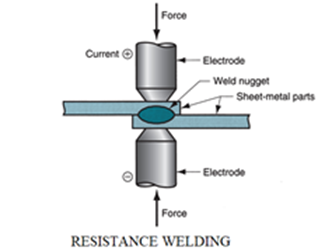
This process generates heat by passing electric current through the metal parts while applying pressure.
a) Spot Welding
- Joins overlapping sheets at specific points
- Common in automotive body production
b) Seam Welding
- Produces continuous welds
- Used for making leak-proof joints
Advantages:
- Fast process
- No filler material required
Limitations:
- Limited to thin materials
4. Solid-State Welding #
In these processes, welding occurs without melting the workpieces.
a) Friction Welding
- Heat generated by mechanical friction between parts
- Common in joining rods, pipes, and shafts
b) Ultrasonic Welding
- Uses high-frequency vibrations
- Common for plastics and thin metals
Advantages:
- No filler or flux required
- Strong and clean joints
5. Energy Beam Welding #
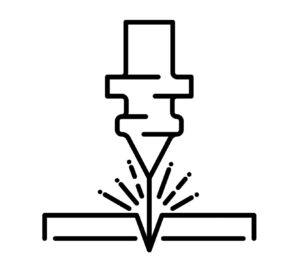
Uses highly concentrated heat sources.
a) Laser Beam Welding (LBW)
- Uses a laser to melt the material
- Precise and suitable for automation
b) Electron Beam Welding (EBW)
- Uses a beam of high-velocity electrons
- Performed in a vacuum
Advantages:
- Deep penetration
- Minimal distortion
Limitations:
- High setup cost
6. Thermochemical Welding #
Thermit Welding
- Uses an exothermic chemical reaction to produce molten metal
- Common for railway track welding
Conclusion & Summary Table #
Welding processes are essential in modern manufacturing and construction. Each type offers unique advantages depending on the material, application, and required strength of the joint. Selecting the appropriate welding process ensures efficiency, safety, and durability in industrial operations.
| Welding Type | Key Feature | Typical Use |
|---|---|---|
| Arc Welding | Electric arc heat | General fabrication |
| Gas Welding | Flame-based | Repair and piping |
| Resistance Welding | Electric resistance + pressure | Automotive sheets |
| Solid-State Welding | No melting | Precision components |
| Energy Beam Welding | Laser/electron beam | Aerospace, electronics |
| Thermit Welding | Chemical heat | Railway tracks |


