

Failure Mode and Effects Analysis (FMEA) is one of the most important quality core tools used across manufacturing and product development industries. It helps organizations systematically identify potential failure modes, understand their effects and causes, and define controls and actions to reduce risk. With the transition from the AIAG 4th Edition FMEA to the AIAG-VDA FMEA Handbook, a major change was introduced in risk prioritization methodology.
This change is known as Action Priority (AP).

Action Priority replaces the old Risk Priority Number (RPN) approach and provides a more structured, consistent, and safety-focused method to decide where improvement actions are truly required.
Quick Recap: How Risk Is Evaluated in FMEA #
In both Design FMEA (DFMEA) and Process FMEA (PFMEA), the fundamental flow remains the same:
- Identify potential failure modes
- Understand the effects of failure
- Identify causes of failure
- Define existing prevention and detection controls
- Assign ratings for:
- Severity (S) – impact of the failure effect
- Occurrence (O) – likelihood of the cause occurring
- Detection (D) – ability of current controls to detect the failure
Once these three ratings are assigned, the next critical step is risk prioritization, deciding which risks require action first.
Limitations of the Old RPN-Based Risk Analysis #
In the old AIAG 4th Edition FMEA Standard, risk prioritization was done using:
RPN = Severity × Occurrence × Detection
Although widely used, RPN has many limitations:
- Equal weighting problem
Severity, Occurrence, and Detection are treated as equally important, which is misleading. A high-severity safety risk could end up with a lower RPN than a low-severity issue. - Same RPN, different risk meaning
Very different combinations of S, O, and D can produce the same RPN value, even though the actual risk levels are not comparable. - Inconsistent prioritization across organizations
Many companies created their own internal rules such as S×O, O×D, or severity thresholds, leading to inconsistency. - Weak focus on safety and customer impact
RPN does not clearly emphasize high-severity failure effects.
Because of these drawbacks, the industry needed a single, standardized, and risk-based decision system.
Concept of Action Priority (AP) in AIAG-VDA FMEA #
The Action Priority (AP) concept was introduced to overcome the limitations of RPN.
Instead of calculating a numeric value, the AIAG-VDA approach uses a Action Priority Table that gives risk based on the combination of Severity (S), Occurrence (O), and Detection (D).
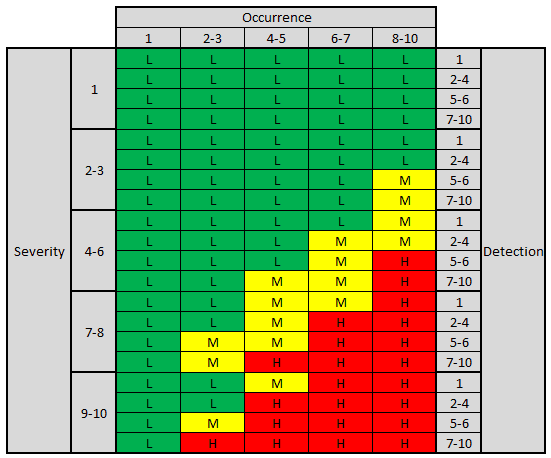
Key characteristics of Action Priority:
- Based on thousands of evaluated S-O-D combinations
- Provides a clear visual decision output
- Uses only three priority levels:
- H – High Priority
- M – Medium Priority
- L – Low Priority
- Ensures consistent risk prioritization across organizations
- Places strong emphasis on severity and safety-related risks
The Action Priority table is mandatory to use once S, O, and D ratings are assigned.
Understanding the Action Priority Levels in Detail #
High Action Priority (H)
A High (H) Action Priority indicates unacceptable or critical risk.
- These items must be reviewed by the cross-functional FMEA team and management.
- The team is expected to identify and implement recommended actions to:
- Reduce Occurrence (O) by improving prevention controls, and/or
- Improve Detection (D) by strengthening detection methods.
- The objective is to reduce the risk from High to Medium or Low.
- If no feasible action exists, a clear technical justification is mandatory, and management must formally accept the risk, confirming that current controls are adequate.
High AP items often involve:
- Safety-related failure effects
- Regulatory or legal risks
- Significant customer dissatisfaction or warranty impact
Medium Action Priority (M)
A Medium (M) Action Priority shows moderate risk that still requires attention.
- These items should be reviewed by the FMEA team and management.
- Improvement actions are recommended but may be decide based on feasibility, cost, and benefit.
- If no action is taken, documented justification is required explaining why current controls are sufficient.
Medium AP typically applies to:
- Performance-related issues
- Process variation risks
- Failures with manageable impact but improvement potential
Low Action Priority (L)
A Low (L) Action Priority indicates low risk.
- No immediate action is required.
- The team may optionally review these items for continuous improvement.
- Existing prevention and detection controls are generally considered adequate.
As stated in the AIAG-VDA handbook:
“It may be helpful to include a statement such as ‘No further action is needed’ in the Remarks field as good practice.”
Low AP items still remain part of the FMEA for knowledge retention and future reference.
Why Action Priority Is Better Than RPN #
Action Priority provides several advantages over traditional RPN:
- Clear and unbias decision-making
- Strong focus on severity and safety
- Eliminates confusion from identical RPN values
- Creates a common global standard
- Aligns FMEA outcomes with management decision processes
- Improves audit readiness for IATF 16949 and customer audits
Action Priority in DFMEA and PFMEA #
The Action Priority is applicable to:
- Design FMEA (DFMEA) – focusing on product design risks
- Process FMEA (PFMEA) – focusing on manufacturing and assembly risks
The AP logic remains the same in both cases, ensuring consistent risk evaluation throughout the product lifecycle.
Conclusion #
Action Priority (AP) is a major evolution in FMEA risk analysis introduced by the AIAG-VDA FMEA Handbook. It replaces RPN with a more robust, severity-driven, and standardized approach to risk prioritization.
By correctly applying Action Priority, organizations can:
- Focus resources on what exactly matters
- Improve product and process safety
- Make better engineering and management decisions
- Strengthen overall FMEA effectiveness
FAQ #
Previously there is lot of confusion with RPN treshold criteria. Many OEM’s have their own set of standard for FMEA and Risk Prioritization criteria. And RPN is not realy justifying the actual risk. For that new FMEA Action Priority is introduced in AIAG-VDA FMEA.
It is recommend to do the review of all medium risk in FMEA by the management, and provide the suitable action to reduce the risk from medium to low.
But sometimes there is no possibility to implement the action due to process constraint, cost and management decision. It is advisable to justify the medium risk with appropriate comments and communicate the same risk to customer.


